International Port Visit by Students of PGDM-International Business Program


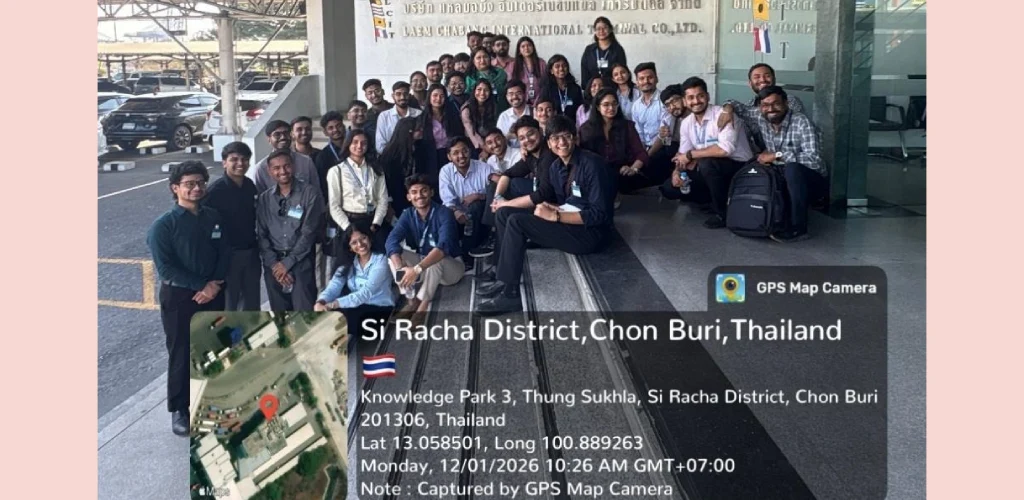
Delegation: Students of PGDM-International Business, Batch 2025-27 of Birla Institute of Management Technology, Greater Noida, Uttar Pradesh, India
Date: January 12, 2026
Location: Laem Chabang International Terminal, Chonburi Province, Thailand
On the second day of the Thailand expedition, students undertook a seaport visit to Laem Chabang Port, Thailand's primary deep-sea port and a critical node in the ASEAN supply chain. The visit was structured to provide a comparative analysis of maritime logistics, contrasting Thailand's "Landlord Port" model with India's evolving maritime policies. The session combined a high-level corporate briefing with an on-site technical tour, facilitating a two-way academic exchange between the port officials and the visiting delegation.
Upon arrival at the Laem Chabang Port Visitor Center, the group was received by two officials from the Port Authority of Thailand (PAT). The group was escorted to the Visitor Center. This facility serves as the port's knowledge hub.
Two senior port officials conducted a comprehensive presentation covering the operational and strategic dimensions of the port.
The core of the presentation focused on Laem Chabang's governance structure. The officials explained that the port operates under a Landlord Port Model, a key differentiator from many older, service-oriented ports.
Role of PAT: The officials detailed how the Port Authority of Thailand (PAT) retains ownership of the land and basic infrastructure (dredging, breakwaters, and main roads).
Private Sector Role: Commercial operations are leased to private terminal operators (such as Hutchison Ports, APM Terminals, and TIPS) via long-term concession contracts. This allows the port to leverage private sector efficiency and technology while maintaining state oversight.

The presentation highlighted Laem Chabang's status as one of the world's busiest container ports (consistently ranking in the top 25 globally). The officials presented data on the port's capacity to handle Super Post-Panamax vessels—ships too large to pass through the Panama Canal—which is essential for direct exports to North American and European markets.

A significant portion of the briefing was dedicated to Phase 3 Development. The officials outlined the port's ambitious expansion goals, which aim to increase total capacity from approximately 11 million TEUs (Twenty-foot Equivalent Units) to 18 million TEUs. They discussed the integration of the Single Rail Transfer Operator (SRTO) system, designed to shift cargo movement from road to rail, reducing carbon emissions and traffic congestion—a critical sustainability goal for the region.
Following the PAT briefing, three BIMTECH students took the stage to present on "India's Port Expansion Policy," offering a comparative perspective from the Indian subcontinent.
i) Sagarmala Programme: The students outlined India's flagship initiative for port-led prosperity, focusing on the reduction of logistics costs for EXIM trade and the development of Coastal Economic Zones (CEZs).
ii) Maritime India Vision 2030 (MIV 2030): The presentation highlighted key pillars of MIV 2030, such as developing "Smart Ports" through digitization, increasing trans-shipment volumes within India to reduce dependency on foreign hubs, and the "Waste to Wealth" sustainable dredging initiatives.
iii) Strategic Parallels: The students drew parallels between Thailand's Eastern Economic Corridor (EEC) and India's Sagarmala, discussing how both nations are pivoting towards port-proximate industrialization to boost manufacturing competitiveness.

This session concluded with a Felicitation Ceremony. The port officials commended the students for their insight into macro-logistics policies. Faculty members then presented tokens of appreciation to the PAT officials, cementing the academic relationship between the institutions.

The visit culminated in a guided bus tour of the restricted terminal areas, offering a ground-level view of operations.
i) Terminal Operations: The bus navigated past the active terminals (Basins 1 and 2), allowing students to witness the seamless interface between land and sea logistics.
ii) Quayside Technology: The group observed the massive Ship-to-Shore (STS) Gantry Cranes in operation. These cranes, some of which are likely remote-controlled at newer terminals like Terminal D, demonstrated the precision required to load and unload thousands of containers daily.
iii) Cargo Management: The tour provided visual evidence of the "stacking" logistics managed by Rubber Tyred Gantry (RTG) cranes, illustrating the complexity of yard management systems that ensure the right container reaches the right truck or vessel at the exact moment required.

Following the tour, the group departed the port complex. This visit provided the students with a tangible understanding of global supply chain mechanics, successfully bridging the gap between their classroom studies on operations management and the real-world execution of a world-class logistics hub.



For Admission Inquiries